
From Plac Zgody to Ghetto Heroes Square
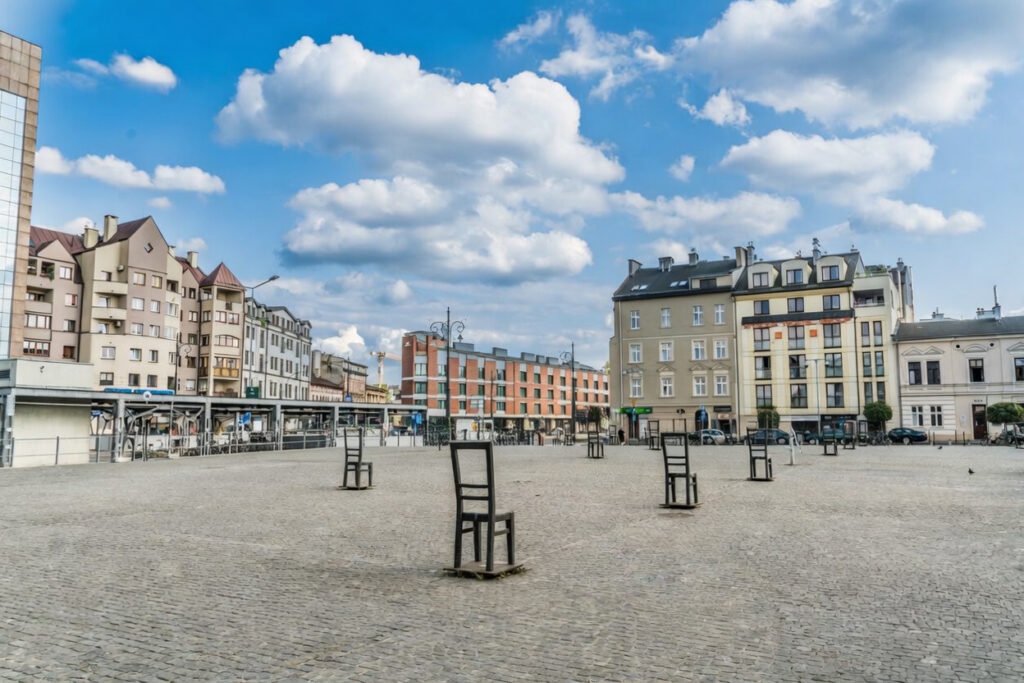
The square wasn’t always a memorial. Until the 1940s it was Plac Zgody – Concord Square – an ordinary market square in Podgórze, a district south of the Vistula that most Kraków residents barely thought about. That changed in March 1941, when the occupying authorities sealed off part of Podgórze and forced roughly 15,000 Jewish residents of Kraków into it, creating the Kraków Ghetto within walls built to resemble Jewish gravestones. Plac Zgody sat at the centre of that sealed district, and it became the square where deportations were organised – first to forced labour, later to Płaszów and Auschwitz. During the ghetto’s final liquidation on 13–14 March 1943, those judged too old, too young, or too ill to work were shot in the square itself; the rest were marched from here to the trains. In 1948, the city renamed the square Plac Bohaterów Getta – Ghetto Heroes Square – to mark what had happened on that ground.Tadeusz Pankiewicz and the Eagle Pharmacy
Across the square stands a modest building that once housed Apteka pod Orłem – the Eagle Pharmacy – run by a Polish pharmacist named Tadeusz Pankiewicz. When the ghetto was sealed, Pankiewicz was offered the chance to relocate his pharmacy outside the walls. He refused, and stayed inside the ghetto for its entire existence, using the pharmacy to pass messages, smuggle small amounts of food and medicine, and quietly document what he witnessed from his window. His memoir, written after the war, described Plac Zgody on the day of a major deportation: furniture and belongings left scattered across the square by families who assumed they were only being relocated, not sent to their deaths. That single detail – abandoned furniture in an empty square – became the starting point for the memorial that stands there today. The pharmacy building now houses a small museum run by the Museum of Kraków, and it’s worth the short stop before or after seeing the chairs.The 2005 memorial and its 33 large chairs
What the chairs are meant to represent
The architects considered and rejected a literal memorial – statues of people, or photographs of the deportations – on the grounds that no single image could carry the scale of what happened here. Instead, they built the memorial around absence: each large chair is estimated to represent roughly a thousand people, standing in for the crowd that once filled this square and never returned to it. The chairs face the direction the deportees were marched, toward the former rail platform at the square’s edge. Three of them face south, toward Lwowska Street, where a surviving fragment of the ghetto wall – built in a shape recalling Jewish tombstones – still stands behind a small memorial plaque. A paved line cutting across the square marks where the ghetto’s boundary once ran, easy to miss unless you’re looking for it.Visiting Ghetto Heroes Square
The square sits in Podgórze, on the south bank of the Vistula, about a 10-minute walk from Schindler’s Factory Museum and a similar distance from central Kazimierz across the river. It’s open at all hours, free to visit, and rarely crowded, since it draws far fewer visitors than the Old Town sights on the other side of the river. Fifteen to twenty minutes is enough to see the square itself and read the surrounding information panels, though most visitors find it worth pausing longer than that. The pharmacy museum across the square adds another 30 to 45 minutes if you want the fuller context behind what you’re looking at. Because the square works best understood alongside Schindler’s Factory and the surviving stretch of ghetto wall nearby, most people see all three in the same visit rather than as separate trips.Seeing it as part of a wider Ghetto district route
Ghetto Heroes Square rarely stands alone on an itinerary – most visitors reach it while covering the wider former ghetto district in Podgórze, including the wall fragment on Lwowska Street and Schindler’s Factory itself. Walking between all three on foot is straightforward, but it does mean crossing several open streets and the same tram lines the deportees once stood beside, with no shade or shelter if the weather turns. For visitors who’d rather have the historical context explained as they go rather than piece it together from panels, the Jewish Ghetto tour covers this square alongside Schindler’s Factory and the ghetto wall, with a local guide filling in the background between stops.Frequently asked questions
There are 70 chairs in total: 33 large bronze and iron chairs arranged across the open square, plus 37 smaller chairs around the tram platforms and edges. Most photographs and first impressions focus on the 33 large ones, since they’re the most visible from a distance.
The chairs reference an account by pharmacist Tadeusz Pankiewicz, who witnessed furniture and belongings left scattered across the square by families deported from the ghetto in 1943, believing they were only being relocated. The empty chairs stand in for that absence rather than depicting the event directly.
It’s in Podgórze, on the south bank of the Vistula, roughly a 10-minute walk from Schindler’s Factory Museum and a similar distance from Kazimierz across the river.
Yes – it’s an open public square with no entry fee or set hours. The Eagle Pharmacy museum on its edge does charge admission if you want to go inside.
Fifteen to twenty minutes covers the square and its information panels. Add 30 to 45 minutes if you also visit the Eagle Pharmacy museum on its edge.