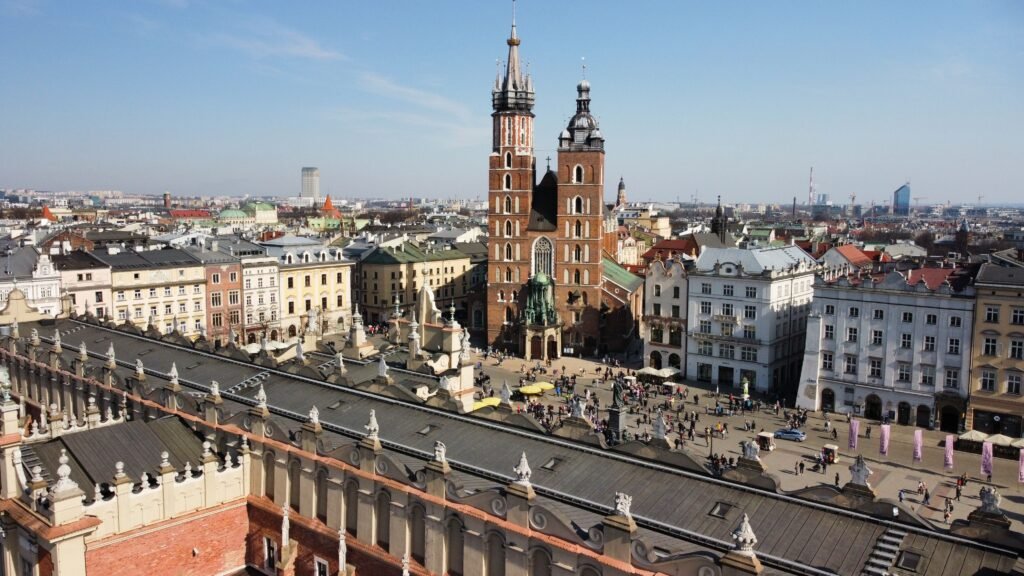
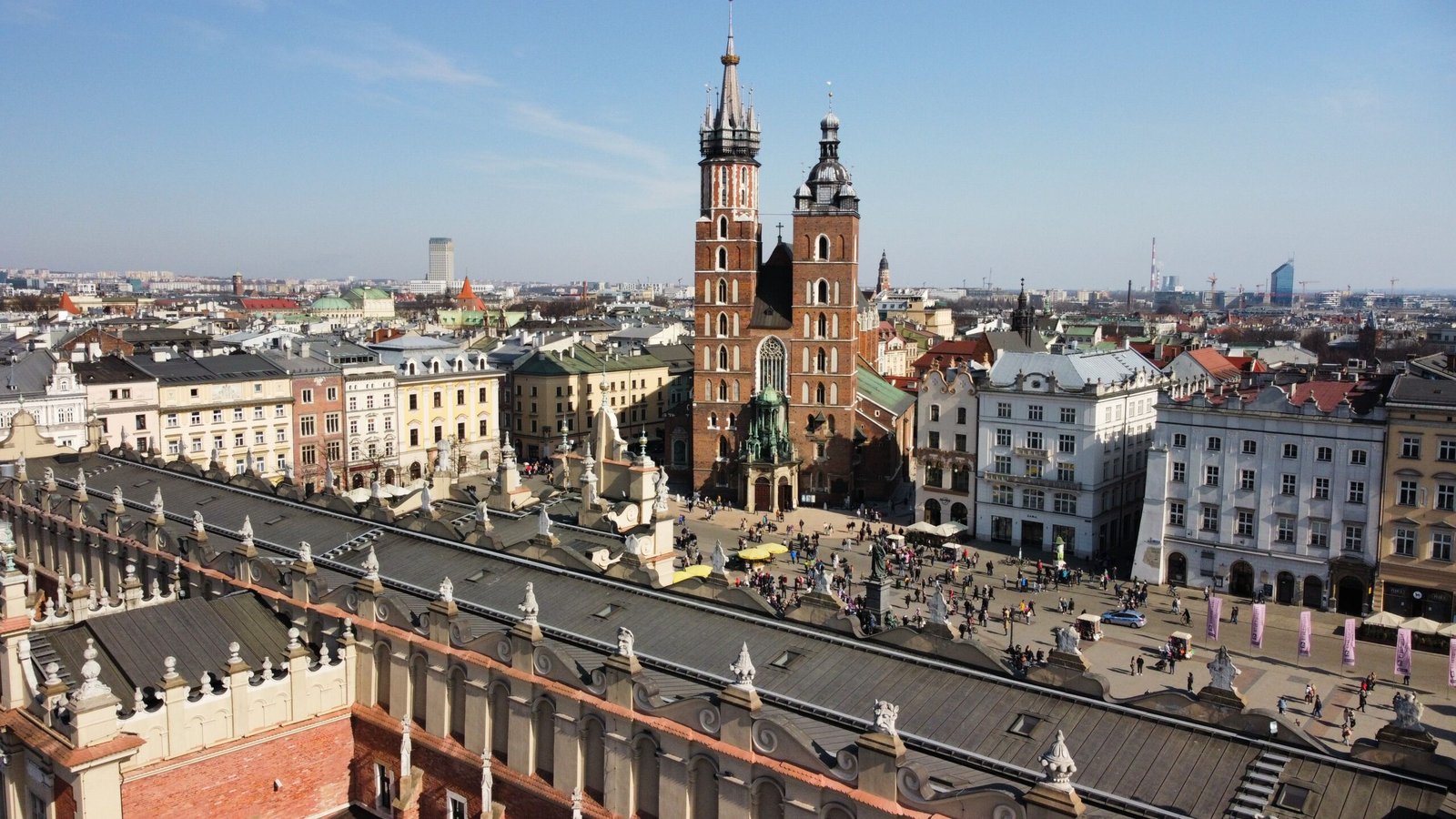
Kraków’s Old Town is small enough to walk end to end in an afternoon, and old enough that it hasn’t needed to change its layout in seven hundred years. Kings once processed down these same streets to be crowned; merchants once haggled under the same stone arches you’ll walk past today. This guide turns that history into a route – where to start, what each landmark actually is, and how long to give each stop, plus quick facts along the way so you don’t need to squint at plaques to know what you’re looking at.
 Every cart on every route runs with onboard speakers playing a multilingual audio guide, so even the shortest single-district loop gets the same running commentary as the longer combo tours.
How to plan a Kraków Old Town walking tour
The whole district sits inside Planty, a ring-shaped park planted where the medieval city walls used to stand. That means the Old Town has a natural boundary you can see on any map – everything worth seeing sits inside that green ring, or just beyond it on Wawel Hill.Quick facts: the district at a glance
- Founded in the 13th century, on a street grid laid out in 1257 that’s barely changed since
- One of the first twelve sites ever added to the UNESCO World Heritage list, in 1978
- Survived the Second World War almost entirely intact, unlike most historic centres in Poland
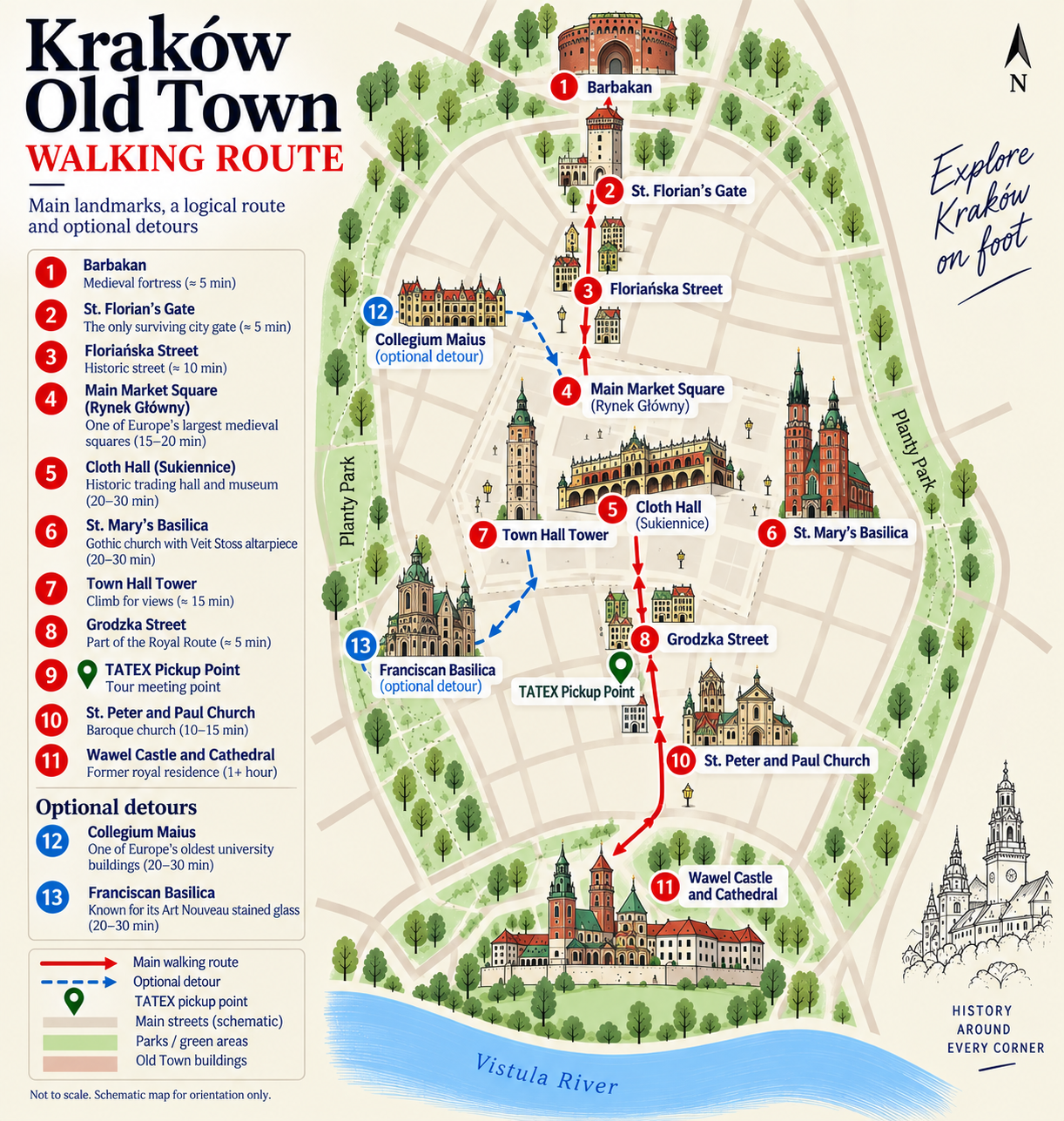
All 13 stops on the route, mapped in order from the Barbican down to Wawel Hill.
The walking route, landmark by landmark
St. Florian’s Gate and the Barbican
Start where the route always started: at the city’s northern threshold. St. Florian’s Gate is the last of the Old Town’s original eight gates still standing, and it’s flanked by a chapel holding an icon locals credit with saving the city from a 17th-century Swedish siege. A short walk beyond it, the Barbican rises like a stone drum – a defensive outpost once connected to the gate by a covered passage.- Gate built around 1300; the Barbican added in 1499 as an extra ring of defence
- The Barbican is the largest surviving structure of its kind in Europe
- Both once formed part of a 3-kilometre wall with 47 towers – almost none of which survive today
Floriańska Street
From the gate, Floriańska Street runs like an arrow straight to the Main Market Square. It’s busy and commercial now, but it’s carrying out the same job it always has – this was the final stretch of the Royal Route, walked by coronation processions for over 500 years.Main Market Square (Rynek Główny)
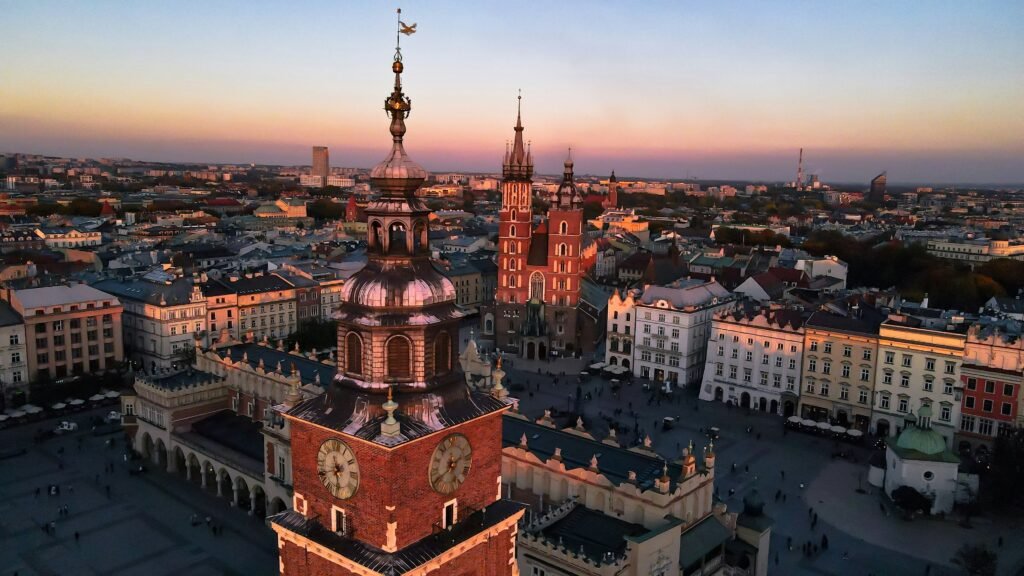
The square opens up all at once at the end of the street, and it’s worth standing still for a moment before heading toward any single landmark.- Laid out in 1257, making it one of the oldest planned town squares in Europe
- At roughly 200 by 200 metres, it’s still one of the largest medieval market squares on the continent
- The original merchant houses lining it have stood, rebuilt and remodelled, since the 14th century
The Cloth Hall (Sukiennice)
Standing squarely in the middle of the square, the Cloth Hall has been Kraków’s trading floor for over 600 years – merchants once sold cloth, spices, and goods carried in from the East here, and traders still sell souvenirs from the same stalls today.- Built in the 14th century, rebuilt in Renaissance style after a fire in 1555
- Ground floor: amber, wood carvings, leather goods
- Upper floor: a gallery of 19th-century Polish painting, run by the National Museum
St. Mary’s Basilica
On the square’s northeast corner, two mismatched towers mark St. Mary’s Basilica – mismatched on purpose, according to local legend, after the two brothers building them turned it into a rivalry that ended badly for one of them.- The wooden altarpiece inside, carved by Veit Stoss, stands 13 metres tall and took 12 years to complete (1477–1489)
- Every hour, a trumpet call plays from the taller tower and cuts off mid-note. Legend ties it to a medieval watchman struck by an arrow mid-warning, though historians generally treat the story as a later embellishment rather than a recorded event
- The taller tower is 81 metres; its twin stops at 69
Town Hall Tower
A short walk from the basilica, the Town Hall Tower is the only surviving piece of Kraków’s original city hall – the rest was demolished in the 1820s to open up more of the square.- 110 stone steps to the top, with views straight down the length of the square
- Basement level once served as a prison; local legend places a headless ghost there
- Leans slightly off vertical – about 55 centimetres, if you’re checking
Grodzka Street and St. Peter and Paul Church
South of the square, Grodzka Street picks up where Floriańska left off, continuing the Royal Route toward Wawel. It’s quieter and more residential, and it passes Kraków’s first Baroque church, its façade lined with statues of the twelve apostles.- Church built 1597–1619, modelled partly on the Gesù church in Rome
- The apostles outside are 20th-century replacements – the originals wore down from centuries of Kraków’s weather
- Foucault’s pendulum, demonstrating the Earth’s rotation, swings inside during museum hours
Wawel Hill: the castle and cathedral
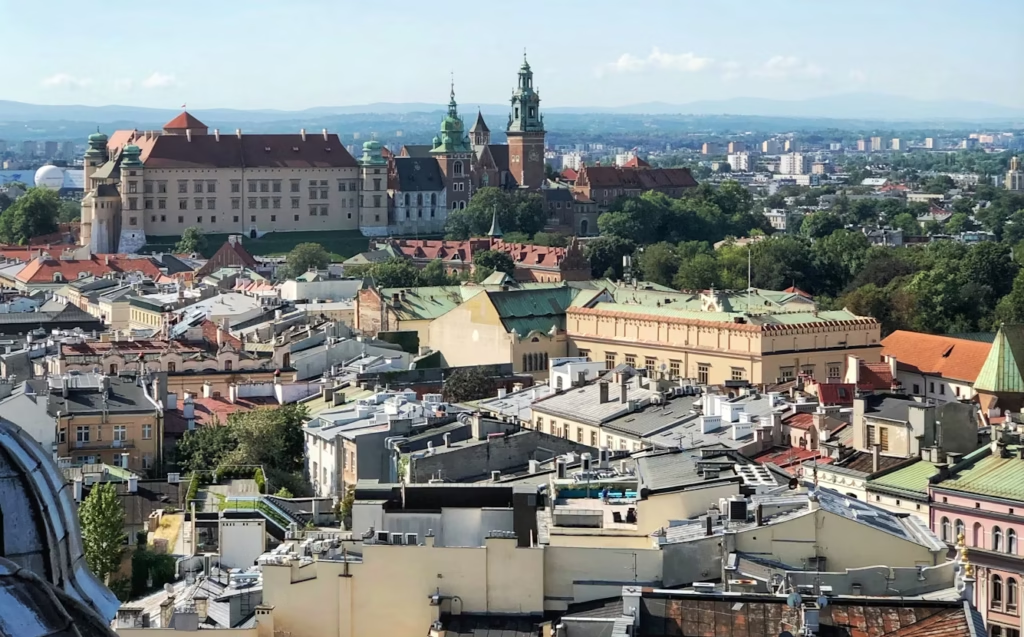
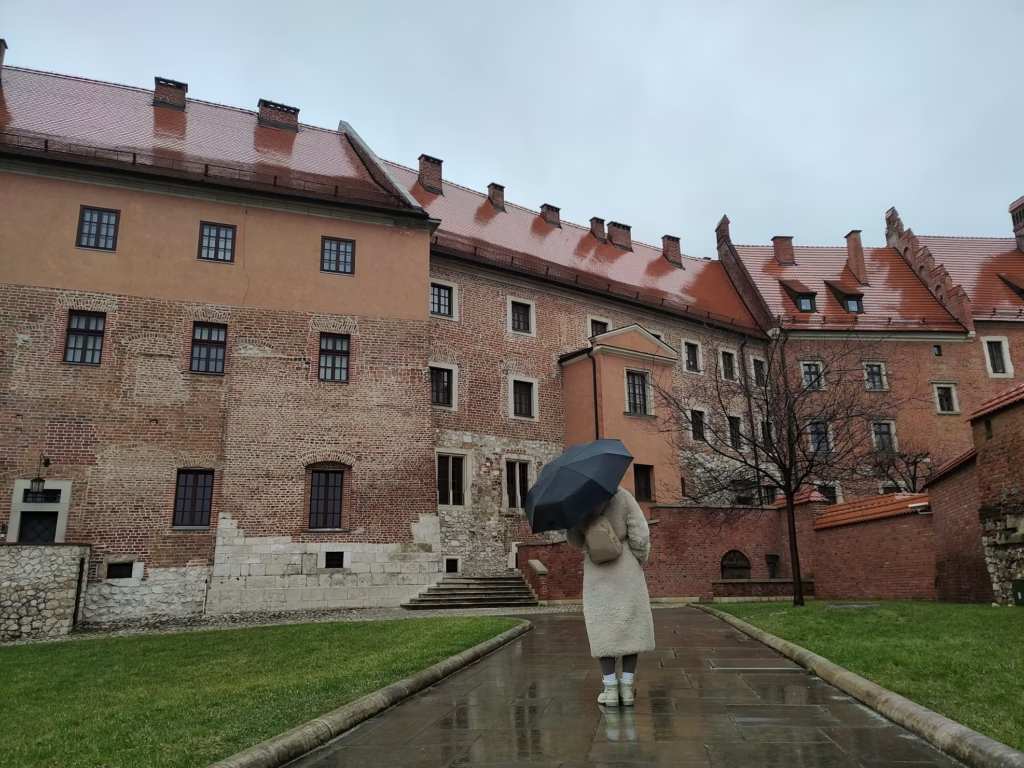
The route ends where Polish history effectively begins – on a limestone hill above the Vistula that’s been fortified since the 9th century.- Royal residence from the 11th century until the capital gradually shifted to Warsaw around 1596
- The cathedral holds the tombs of nearly all Polish monarchs, plus national poets and heroes
- Legend places a dragon’s lair in the caves beneath the hill – a bronze dragon statue at the base still breathes fire every few minutes
Planty Park (the way back)
If you’re walking back rather than catching transport, Planty offers a calmer route than retracing your steps. It follows the exact footprint of the demolished city walls all the way around the Old Town – a green ring where a stone one used to stand.How long the full route actually takes
Walked briskly with no stops, the route takes about 90 minutes. Realistically, once you factor in the Cloth Hall, St. Mary’s Basilica, and a proper look at Wawel, most visitors land closer to 3–4 hours. Starting before 9:00 buys you a quieter square and shorter queues at the more popular stops.Old Town landmarks worth a short detour
Two sights sit just off the main route and reward a slight detour. Collegium Maius, part of the Jagiellonian University founded in 1364, is one of the oldest university buildings in Europe – five minutes west of the square. The Franciscan Basilica, a short walk southwest, is worth stepping into for its Art Nouveau stained glass alone. Neither adds more than 20–30 minutes to the day.Book a tour of the route
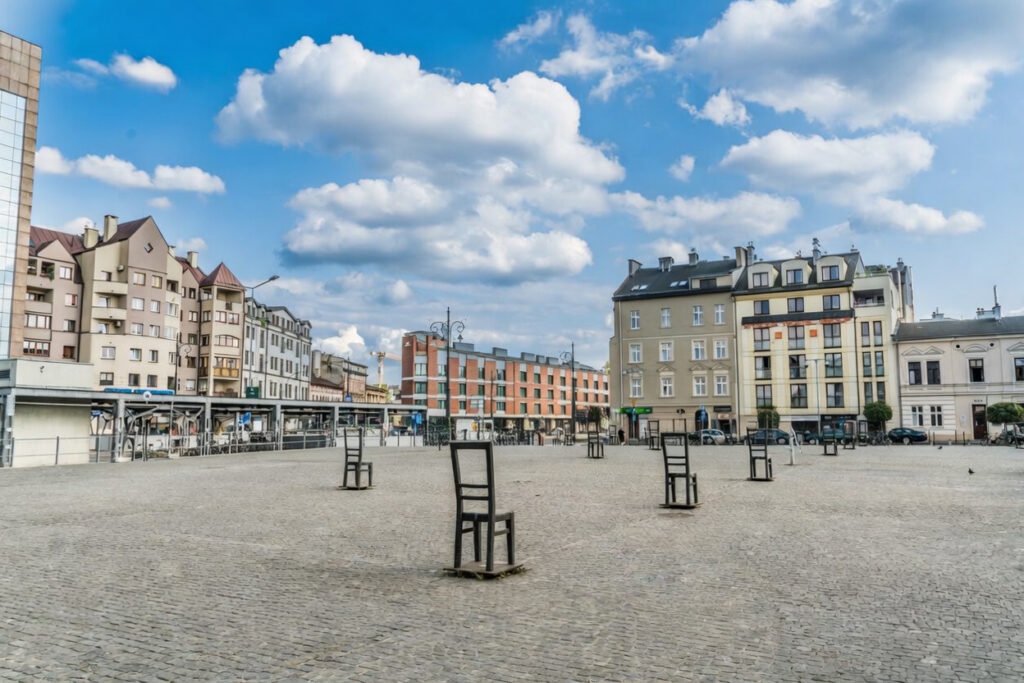
Walking the route above is entirely doable on your own – it’s free, flexible, and nothing beats setting your own pace through a 700-year-old market square. But it does mean covering roughly 2 kilometres on foot, on cobblestones, with the history pieced together from plaques as you go. If you’d rather skip the walking – or combine it with Kazimierz or the former Jewish Ghetto in the same day – Tatex Tour runs private electric golf cart tours along this same route, with a local driver narrating the history at each stop instead of you looking it up. Every cart seats a small group only (never mixed with strangers), and each one comes fitted with onboard speakers playing a multilingual audio guide, so the commentary keeps going even between landmarks. Our pickup point sits right on this walk: plac Wszystkich Świętych 11, at the corner of Grodzka and Dominikańska streets, just past St. Peter and Paul Church. Easy to find whether you’re passing it on foot or booking ahead.Get directions to our pickup point – open in Google Maps.
Show your driver this article for 10% off with the code TATEX10
Combo tours
Frequently asked questions
Starting at St. Florian’s Gate and finishing at Wawel Hill follows the historic Royal Route, stringing together the Main Market Square, Cloth Hall, St. Mary’s Basilica, and Grodzka Street in one logical line.
Yes, comfortably, in a morning or afternoon on its own – add Kazimierz or the former Jewish Ghetto and a full day becomes the more realistic estimate.
Early – before 9:00, if you can. The Main Market Square and the Cloth Hall fill up noticeably by mid-morning, and St. Mary’s Basilica gets its longest entry queue right around midday.
Yes – it’s compact and well signposted. A guide or audio commentary just adds the historical layer you’d otherwise have to look up yourself.