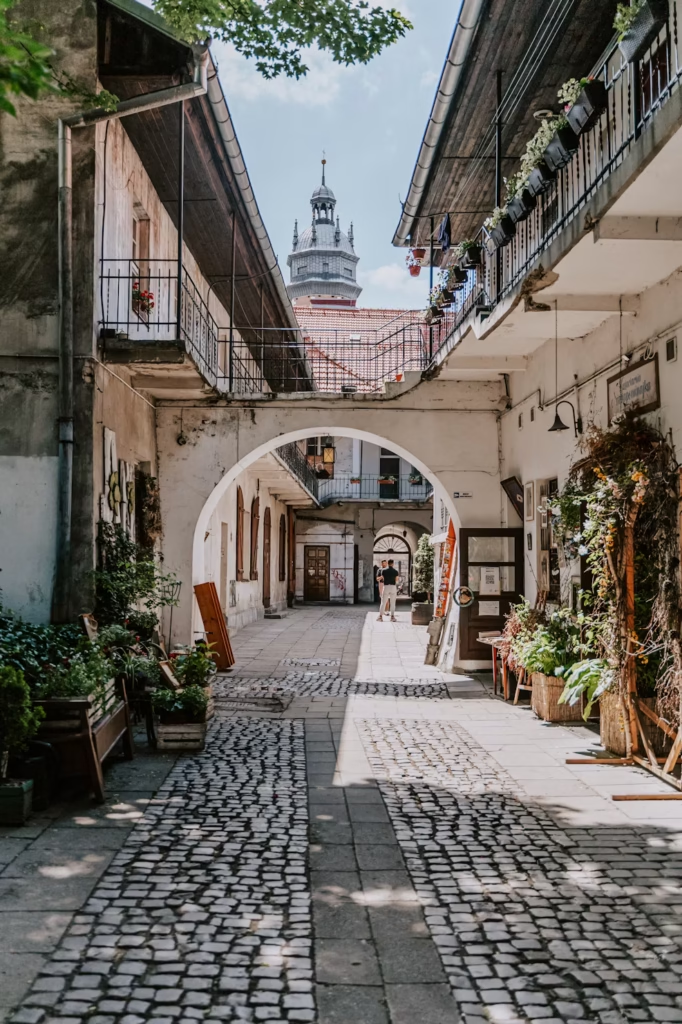
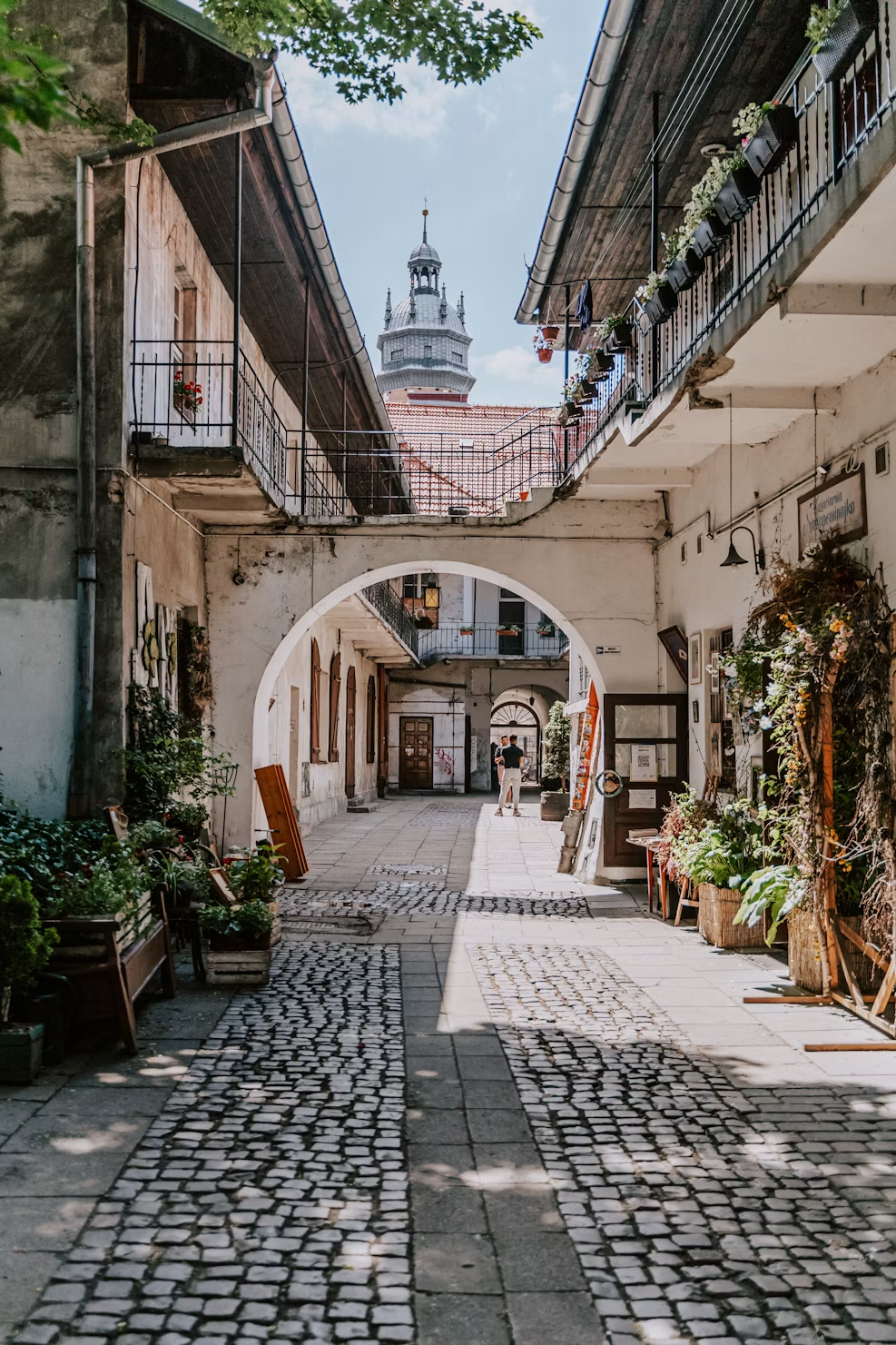
The history of Kazimierz, Krakow’s Jewish Quarter
Kazimierz Krakow history is easiest to follow as a handful of distinct chapters, each one reshaping the district completely.| Period | What happened |
|---|---|
| 1335 | King Casimir the Great founds Kazimierz as an independent town on a Vistula island, separate from Kraków. It starts as a mixed town – Christian and Jewish communities living side by side. |
| 1495 | King Jan Olbracht expels Jews from Kraków proper and resettles them in northern Kazimierz. The forced move becomes the foundation of the Jewish Town. |
| 16th–17th c. | A golden age: the Old and Remuh Synagogues are built, and Rabbi Moses Isserles becomes one of Europe’s leading Jewish scholars. Plague, fire and Swedish invasion later slow the growth, but the community endures. |
| 1800–1939 | Kazimierz is formally absorbed into Kraków. An 1867 reform lets Jewish residents live anywhere in the city, yet Kazimierz stays the spiritual centre. By 1939, roughly 64,000 Jews – a quarter of Kraków’s population – call the city home. |
| 1941–1945 | The Nazi occupiers force Kraków’s Jewish population out of Kazimierz entirely, into a walled ghetto across the river in Podgórze – not in Kazimierz itself. Most of those confined there are later murdered in the camps. |
| Since 1988 | A slow revival gathers pace after the fall of communism and accelerates once Schindler’s List is filmed here in 1993. The annual Jewish Culture Festival, restored synagogues and a small active Jewish community turn Kazimierz back into a living centre of Krakow Jewish heritage. |
- Kazimierz founded as an independent town in 1335, by King Casimir the Great
- Jewish community resettled here from 1495, following an expulsion from Kraków proper
- Around 64,000 Jews lived in Krakow before 1939 – roughly a quarter of the population
- The wartime ghetto stood across the river in Podgórze, not in Kazimierz itself
- The Jewish Culture Festival has run here every summer since 1988
Here’s the full route, with every stop mapped in order: open this Kazimierz walking route in Google Maps.
Kazimierz walking route: landmark by landmark
Kazimierz rewards a slow, looping walk rather than a straight line, but the stops below are ordered to actually flow into each other on foot – starting at the district’s eastern edge and finishing at its southern square, a natural point to continue on toward Podgórze.Galicia Jewish Museum
The Galicia Jewish Museum makes a natural first stop – it sits on Dajwór Street, at Kazimierz’s eastern edge. It takes a deliberately different approach to Jewish heritage Krakow: rather than a historic building, it’s a modern photography museum, founded in 2004 by British photojournalist Chris Schwarz. Its permanent exhibition, Traces of Memory, documents Jewish life across the wider Galicia region both before and after the Holocaust – as much about survival and revival as about loss, and a useful bit of context before the older sites that follow.- Founded in 2004 by photojournalist Chris Schwarz
- Located on Dajwór Street, in a converted former mill building
- Permanent exhibition “Traces of Memory,” covering Jewish Galicia before and after the Holocaust
Szeroka Street and the Old Synagogue
A five-minute walk west brings you to Szeroka Street. Despite the name (“Wide Street”), it’s really more of a long, narrow square – it functioned as the market square of the Jewish Town for centuries and is still lined with former synagogues, now mixed in with small shops, galleries and café terraces. The Old Synagogue anchors its southern end: the oldest surviving synagogue building in Poland, a squat, fortress-like Gothic structure rebuilt in the Renaissance style after a fire in 1570, thick-walled enough that it doubled as a defensive position when the district needed one. It’s now a branch of the Historical Museum of Kraków, with exhibitions on Jewish religious life and traditions.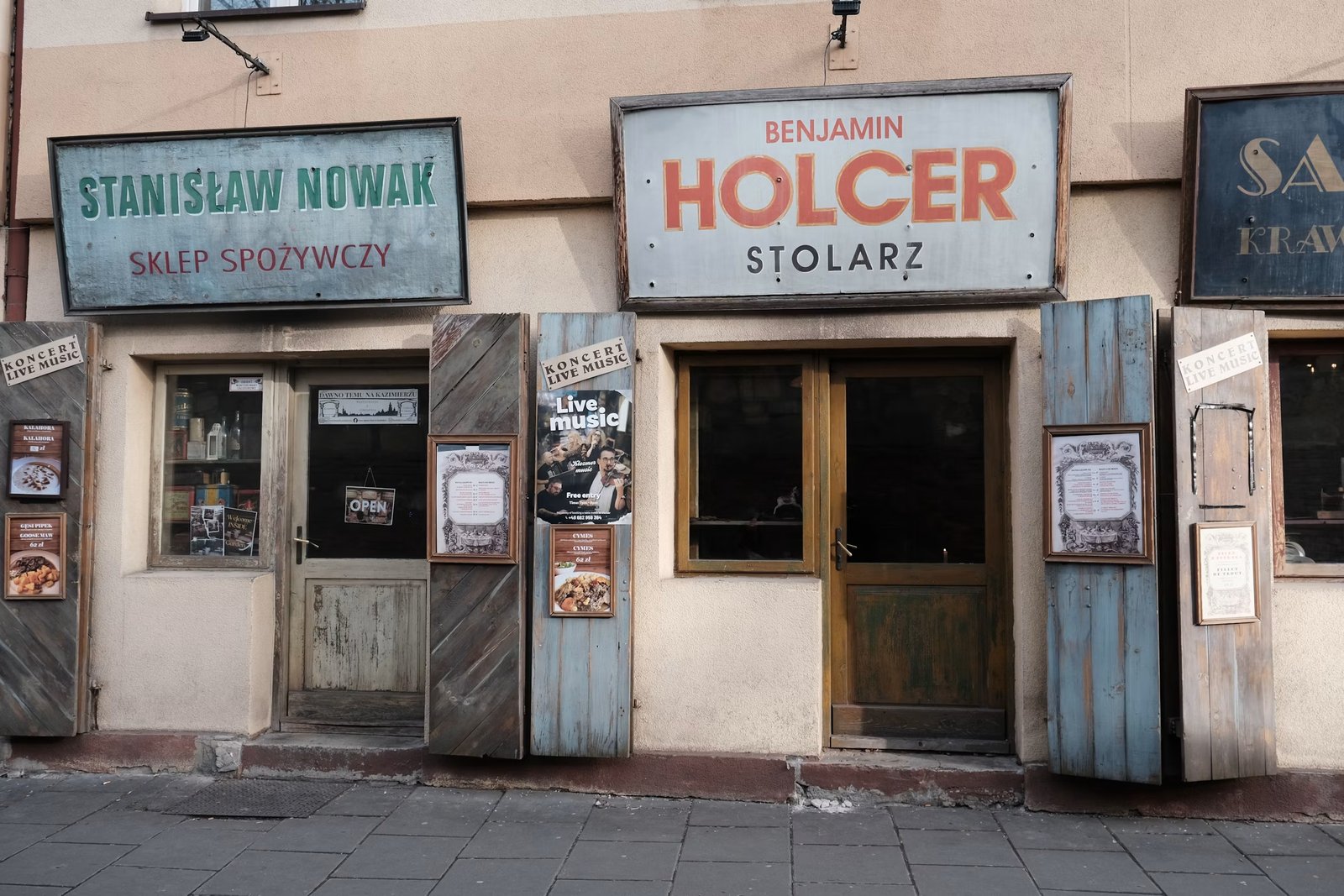
- Built in the 15th century, rebuilt after a fire in 1570
- The oldest surviving synagogue building in Poland
- Now a museum of Jewish history and tradition, on Szeroka Street
Remuh Synagogue and the Old Jewish Cemetery
Walk up the same street and the Remuh Synagogue appears within a couple of minutes. The smallest of Kazimierz’s historic synagogues is also one of only two still holding daily services in Krakow. Built in the 1550s for the family of Rabbi Moses Isserles, it sits beside the Old Jewish Cemetery, established in 1535 and among the oldest Jewish burial grounds still standing in Europe. Isserles’s own grave, tucked against the cemetery wall, is said to be the only one that survived wartime destruction intact – it’s still a pilgrimage site for visitors who come specifically to leave a note at it.- Built around 1553, the smallest of Kazimierz’s synagogues
- One of only two active synagogues in Krakow today
- Adjoining cemetery dates to 1535, among the oldest in Europe
Isaac Synagogue
From Szeroka Street, a short walk west along ul. Kupa leads to the Isaac Synagogue, founded in 1644 by the wealthy merchant Isaac Jakubowicz and the largest of Kazimierz’s synagogues. Looted and gutted during the war, it was restored decades later and today hosts a mix of exhibitions, prayer services and historical film screenings – a useful stop for anyone who wants more context before or after the smaller, quieter synagogues nearby.- Founded in 1644 by merchant Isaac Jakubowicz
- The largest historic synagogue in Kazimierz
- Now used for exhibitions and historical screenings
Kupa Synagogue and Tempel Synagogue
Continuing north-west onto ul. Miodowa brings you to two more synagogues within a hundred metres of each other. Kupa Synagogue, funded in the 1640s by the community’s own treasury (kupa means “fund” in this context), is the plainer of the two. The Tempel Synagogue next door is the newest and most architecturally different of Kazimierz’s synagogues, raised in 1860–1862 for Kraków’s Reform Jewish congregation: its neo-Renaissance interior, with Moorish-style detailing and stained glass, looks closer to a European concert hall than the older, plainer synagogues nearby. It’s still occasionally used for services, and regularly for concerts during the Jewish Culture Festival.- Kupa Synagogue built in the 1640s, funded by the local Jewish community
- Tempel Synagogue built 1860–1862 in neo-Renaissance style with Moorish detailing
- Tempel hosts concerts, especially during the Jewish Culture Festival
Plac Nowy
A couple of minutes south of Miodowa Street, Plac Nowy is arguably the real centre of daily life in Kazimierz today. Its distinctive round building, the so-called Okrąglak, was originally a kosher poultry slaughterhouse; it now houses a ring of stalls selling zapiekanki, Kraków’s open-faced toasted sandwich, day and night. On weekend mornings the square doubles as a flea market, and by evening its bars spill customers out onto the cobbles.- Plac Nowy’s round Okrąglak was originally a kosher slaughterhouse
- Now Kazimierz’s best-known spot for zapiekanki and nightlife
- Hosts a weekend flea market on the square
Kazimierz Market Square (Plac Wolnica)
From Plac Nowy, a straight ten-minute walk south down ul. Bożego Ciała leads to the district’s Christian side and Plac Wolnica – the original market square of independent Kazimierz, laid out alongside the town’s founding charter in 1335, older in fact than the Jewish Town itself. It’s quieter and far less touristed than Kraków’s Main Market Square, ringed by the old Kazimierz town hall, now home to the Ethnographic Museum, and makes a natural place to end the walk – or to continue on toward the river and Podgórze.- Kazimierz’s original market square, dating to the town’s founding in 1335
- Home to the old Kazimierz town hall, now the Ethnographic Museum
- A quieter counterpart to Kraków’s Main Market Square
How long Kazimierz sightseeing actually takes
On foot, with no stops, the core streets of Kazimierz – Szeroka, Józefa, Meiselsa and the square at Plac Nowy – can be covered in under an hour. In practice, a Kazimierz self-guided walking tour that includes even a couple of synagogue interiors and the Galicia Jewish Museum comfortably fills half a day, and a full day is realistic if you’re treating it as a proper Kazimierz one day itinerary alongside a visit across the river to Podgórze.Worth crossing the river: Podgórze, the ghetto and Schindler’s Factory
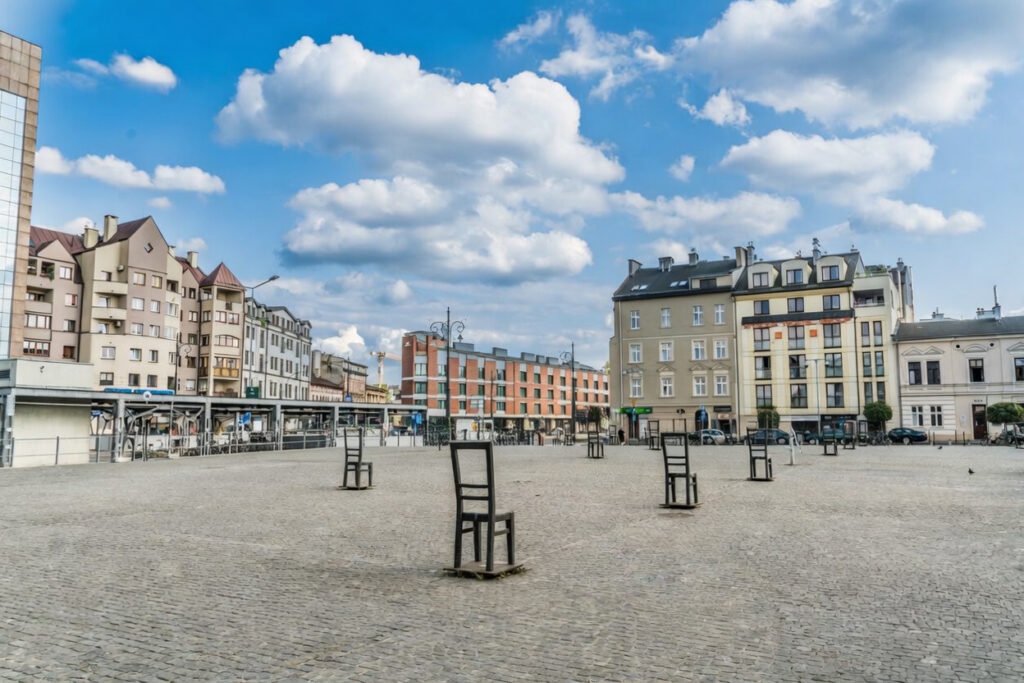
It’s a common misconception that the Nazi-era ghetto stood inside Kazimierz. It didn’t: in 1941, Krakow’s Jewish residents were forced out of Kazimierz entirely and walled into a new ghetto in Podgórze, on the opposite bank of the Vistula. A twenty-minute walk (or a short tram ride) from Kazimierz, Plac Bohaterów Getta – Ghetto Heroes Square – marks the site today with rows of empty bronze chairs, a stark memorial to the residents deported from there to the camps. Fragments of the original ghetto wall survive nearby, its coping stones shaped like tombstones. A short walk further along ul. Lipowa is Oskar Schindler’s former enamelware factory, now the Historical Museum of Kraków’s branch dedicated to the city under Nazi occupation – widely considered one of the best-curated Second World War museums in Poland, and the natural companion to a morning in Kazimierz for anyone piecing together the full story of Jewish history Krakow carries from this period.Book a tour of Kazimierz
Kazimierz is easy enough to explore as a Kazimierz Krakow self guided walking tour – nothing beats wandering its streets at your own pace and ducking into whichever synagogue or courtyard café catches your eye. But if you’d rather have the history explained as you go, or want to combine Kazimierz with the Old Town or the former ghetto in Podgórze in a single outing, Tatex Tour runs private electric golf cart tours covering exactly this route, with a local driver narrating at each stop. Our pickup point is the same corner used for our Old Town tours: plac Wszystkich Świętych 11, at the corner of Grodzka and Dominikańska streets – a short ride from Kazimierz itself.Show your driver this article for 10% off with the code TATEX10
Frequently asked questions
Kazimierz is famous as Kraków’s historic Jewish Quarter – for over five hundred years it was the centre of Jewish life in the city, and today it’s known for its surviving synagogues, the Galicia Jewish Museum, and a lively café and bar scene built into the same streets.
Yes – it’s one of the best places to visit in Kazimierz Krakow for anyone interested in the city’s history beyond the Old Town, and it doubles as one of Kraków’s most atmospheric neighbourhoods for food, coffee and nightlife.
Budget half a day for a comfortable Kazimierz one day itinerary that covers the main synagogues and Plac Nowy, or a full day if you’re adding the Galicia Jewish Museum and a walk across the river to Podgórze.
Both work well. The district is compact and easy to explore as a Kazimierz self-guided walking tour, but a guided golf cart tour is a good option if you’re short on time or want the history explained without stopping to read every plaque.
The Old Synagogue and Remuh Synagogue on Szeroka Street, Plac Nowy for food and atmosphere, and the Galicia Jewish Museum for context are the four places most worth prioritising if your time is limited.
No – this is a common mix-up. The wartime ghetto was in Podgórze, across the Vistula, not in Kazimierz itself. The two are usually visited together, but they’re separate districts with separate histories.